Video Search Is Broken. Here's What Nobody Talks About.
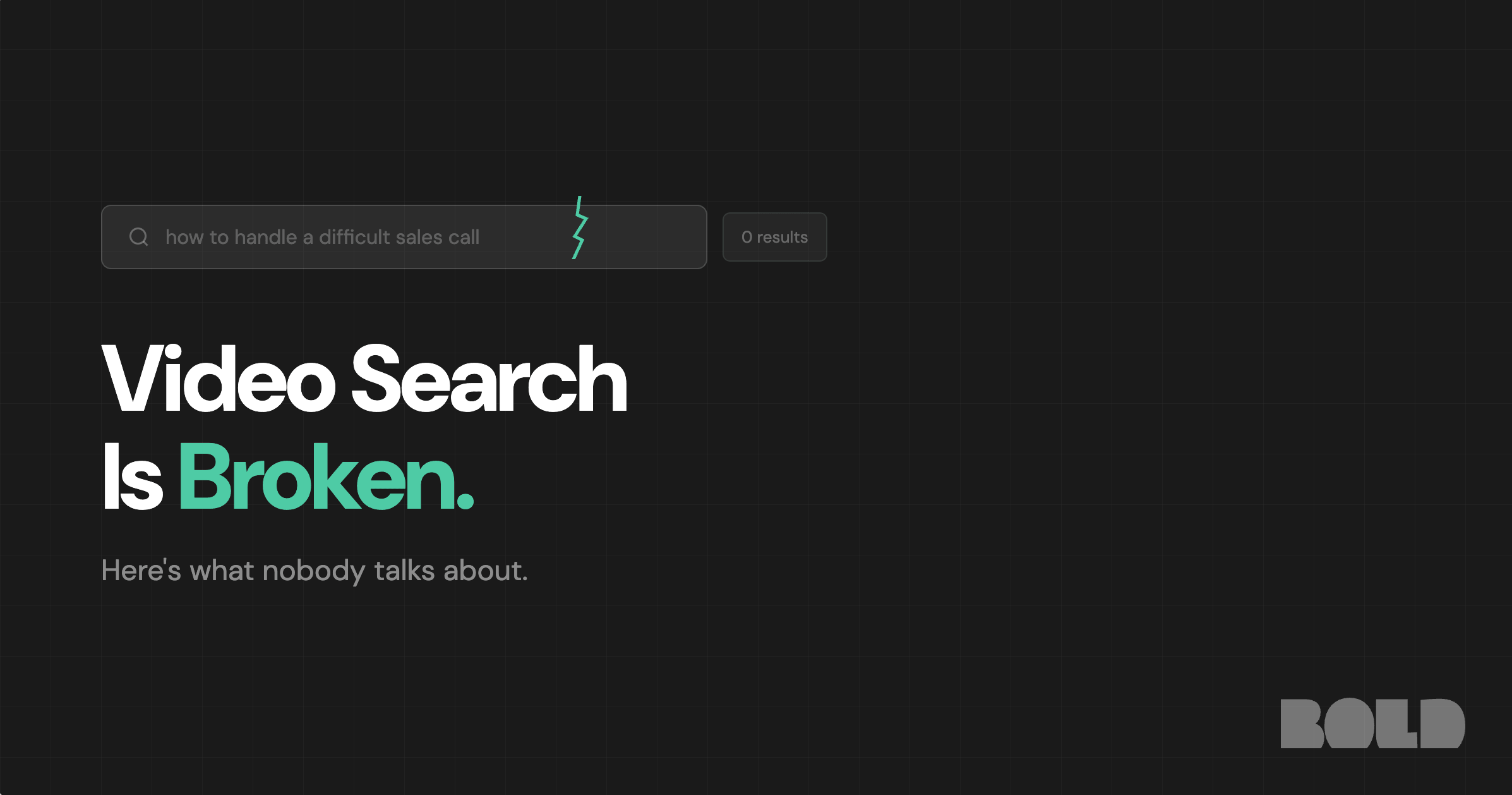
Try this. Open any course platform you've used. Search for "how to handle a difficult sales call." Go ahead, I'll wait.
You probably got one of two results. Either nothing came back because the instructor never used that exact phrase. Or 47 results with the word "sales" highlighted in a wall of auto-generated transcript text, and now you're supposed to figure out which of those gray paragraphs actually answers your question.
Welcome to video search in 2026. It's terrible.
We got really good at hosting video. Encoding it. Streaming it at four quality levels to someone's phone on a train. The plumbing works. But the moment you ask "what's actually in this video?" the whole thing falls apart.
Scrubbing is not searching
The video timeline is a lie. For a talking-head recording - which is what 90% of coaching and training content looks like - that timeline is a featureless desert. Same person, same desk, same shirt, for 47 minutes. No landmarks. No chapters. No indication of when the conversation shifts from pricing strategy to hiring your first employee.
This is the equivalent of flipping randomly through a 200-page book with no table of contents, no index, and every page identical. Nobody would accept that from text. We accept it from video every day.
Transcripts were never meant to be read
"But we have transcripts now!" Sure. Pull one up.
A raw transcript is a wall of text with no punctuation you'd trust, no paragraph breaks that match the actual conversation, and speaker labels that say "Speaker 1" because the system couldn't figure out who was talking. Even when transcription is accurate (and it's gotten very good), the output is optimized for machines.
Nobody sits down and reads a 12,000-word transcript to find the two minutes where the instructor explained how to price a consulting package. They give up. Or they rewatch the whole video. Or, most likely, they don't watch it at all.
That's the real cost. Not frustration. Abandonment.
Keyword search misses. Vector search guesses.
A coach explaining value-based pricing might spend fifteen minutes on the topic without ever saying "value-based pricing." They'll tell a story about a client who tripled their rates. They'll say "anchor to the outcome, not the effort."
Keyword search catches none of this.
So the AI crowd jumps in. "Just embed everything into vectors and do semantic search." I've built this. Here's what happens.
You chop transcripts into chunks, generate embeddings, drop them into a vector database. A student asks "how should I handle it when a client says I'm too expensive?" The system returns chunks from eight different videos. Some are about objection handling. Some about mindset. One is from a video on firing bad clients. Another is a tangent from a guest in an unrelated industry. Similarity scores all within a few points.
The system can't tell a definitive teaching moment from a throwaway comment.
It's not a search problem. It's a comprehension problem.
What "understanding" a video actually requires
A video isn't a bag of words. It has structure. A 45-minute coaching session might cover onboarding in the first ten minutes, transition to retention strategy, and close with a Q&A where half the answers contradict the structured teaching because the coach was riffing.
To search video properly, you need a system that knows the difference.
This is what we build at Bold. Before any question gets asked, we build a real understanding of every video in your library:
→ A per-video understanding of what's actually being taught → Teaching moments separated from tangents, Q&A, and off-topic riffs → Context about who it's for, so answers adapt to the student → Links between lessons, not just isolated clips
The result is an AI teaching assistant that answers in the coach's own words with timestamped citations to the exact clip - not eight half-relevant chunks from a vector DB, not a confident-sounding summary that reference-leaks from three different contexts.
It sounds obvious when you say it out loud. But almost nobody does it this way because it's harder than throwing everything into one big index and hoping the math sorts it out.
The real cost of broken search
There are coaching programs sitting on 200, 300, 500 hours of recorded expertise. The founder spent years creating this content. Production budget was six figures. And their students can't find what they need. So they ask the same questions in Slack. The coaches burn out answering the same ten things every week. Students get frustrated, feel stuck, and churn.
A program with $5 million in annual revenue and 70% retention has a $1.5 million churn problem. Students churn for a lot of reasons, but one of them - the one nobody's measuring - is that they couldn't find the answer they needed at the moment they needed it. The content existed. They paid for it. They just couldn't get to it. That's a search problem sitting quietly inside a retention problem, and it's the one nobody's fixing.
You can't fix it with a better search bar. You fix it by actually understanding what's in the videos.
If you're running a coaching program or training academy and your library is quietly failing your students, we'll show you what Bold does on your content in 30 minutes. See Bold on your library →
- Marcel